How to Store Iodized Salt and How Long Iodine Lasts
A packet of iodized salt sits on a shelf next to the stove, torn open at one corner. Six months later the salt has turned into a rock, and the owner is convinced the iodine is long gone. The second part is a myth roughly twenty years out of date. The first part is true, and it is a storage problem.
Let us go through it in order: what to keep salt in, where to put the jar, how long iodine actually survives in modern salt, and what the Ukrainian standard DSTU 4307:2004 has to say about it.
The short version
- Airtight container: a jar with a screw cap or a container with a gasket, not a torn cardboard packet.
- A closed kitchen cabinet, away from the stove, the radiator and direct sunlight.
- A dry spoon only. The moisture you bring in yourself is the main cause of clumping.
- Modern salt is iodized with potassium iodate (KIO3), not iodide. That is why the shelf life is 9 to 12 months, not 3 to 4.
- Once the date passes, the salt is not spoiled. Under the standard it is simply sold on as ordinary table salt.
An airtight container is rule number one

Salt is hygroscopic: it pulls moisture straight out of the air. The threshold for table salt is well known, at roughly 75% relative humidity. Above that line the crystals start absorbing water vapour, the surface goes damp, and when the air dries out again the wet crystals fuse together. That is how a free flowing product becomes a solid block you have to break up with a knife.
It is no coincidence that the same threshold appears in DSTU 4307:2004: iodized salt must be stored at a relative humidity of no more than 75%. A kitchen with pots boiling on the stove crosses that line every day.
The second job of a tight lid is to limit contact with oxygen and air exchange. The iodizing compound oxidizes and escapes faster the more fresh humid air passes through the salt.
What works in practice:
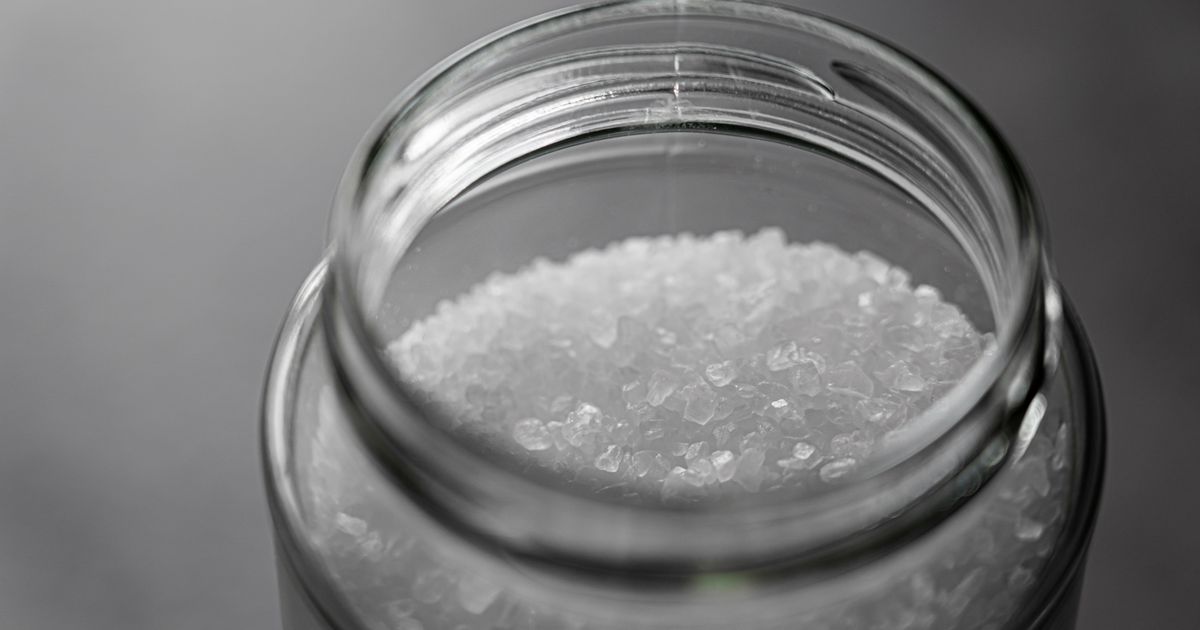
- A glass jar with a screw cap, or a clamp lid jar with a silicone seal.
- A food grade plastic container with a gasket around the lid.
- A ceramic salt cellar with a tightly seated lid. An open salt bowl is fine only for the amount you will use within a week.
What does not work: a torn cardboard packet, a rolled up plastic bag, an open jar next to the stove. This is not about aesthetics, it is about water in the air.
And separately: use a dry spoon. A wet spoon in the salt jar creates a local brine, and a lump forms around it. Most "spoiled" salt is spoiled exactly this way.
A dark and cool place
The standard sets a wide storage temperature range: from minus 20 °C to plus 50 °C. That looks easy to meet in a kitchen. The problem is not the number itself: next to the stove, salt gets not only heat but steam, and on a windowsill it also gets ultraviolet light.
So the working rule is simple:
- A closed kitchen cabinet or pantry, not an open shelf above the hob.
- Not next to the oven, the radiator, the dishwasher or the kettle.
- Not on the windowsill, and not anywhere direct sun hits during the day.
- Not in the fridge. Every trip from cold storage into a warm kitchen leaves condensation on the lid, and that condensation goes back into the salt.
Why the old "iodine evaporates in 3 to 4 months" myth died

The myth did not come from nowhere. It describes the salt that was actually sold for decades.
Before: potassium iodide (KI)
The old iodizing compound is unstable. Iodide oxidizes easily and the iodine leaves as vapour, especially under light, heat, humid air and in the presence of magnesium impurities. In a hot, humid warehouse that salt really did lose a large share of its iodine within months. Hence the folk memory of "salt with no iodine left by summer".
Now: potassium iodate (KIO3)
Iodate is more stable against light, moisture and temperature, which is exactly why it became the global standard for salt fortification. It does not escape from dry salt the way iodide did, and it survives normal warehouse and household storage.
The difference is visible in the Ukrainian standard itself. DSTU 4307:2004 sets the shelf life according to which salt was iodized and with what:
| Salt and iodizing compound | Shelf life |
|---|---|
| Rock and sedimentary salt, potassium iodide (the old scheme) | 6 months from production date |
| Rock and sedimentary salt, potassium iodate | 9 months from production date |
| Evaporated salt, potassium iodide or iodate | 12 months from production date |
So the official 9 to 12 months is not a manufacturer's marketing claim, it is what the standard says. And it counts only if the salt was stored properly: in the producer's packaging, at humidity up to 75% and away from open flame and heat sources. Break the conditions and no date guarantees anything.
How much iodine salt should contain
DSTU 4307:2004 sets the iodine mass fraction at (40 ± 15) · 10-4 %. Converted into familiar units, that is 40 ± 15 mg of iodine per kilogram of salt, a range of 25 to 55 mg/kg.
What is useful about this when you are standing at the shelf:
- Read the ingredients. Modern salt states "potassium iodate" or KIO3. If it says potassium iodide, the shelf life is shorter. That is fine, just take it into account.
- Check the production date, not only the expiry date. The term is counted from production.
- A faint smell of iodine and a light taste of the additive are normal sensory characteristics under the standard, not a defect.
- Small lumps that break apart under light pressure are also permitted. A solid rock is not.
The date has passed. Throw it out?
No. DSTU 4307:2004 states it directly: once the shelf life expires, iodized salt is sold as ordinary table salt. The sodium chloride has not gone anywhere, the salinity is unchanged, and the salt is perfectly usable for cooking.
Only one thing changes: you can no longer count that packet as a source of iodine. If you bought iodized salt specifically to prevent iodine deficiency, buy a fresh pack.
Cooking, preserving and a few practical notes
- Salt at the end. During long boiling part of the iodine leaves with the steam. It does not change the taste, but it does reduce the iodine slightly.
- Use non-iodized salt for fermenting and preserving. Iodine can inhibit fermentation and change the colour of the product. We covered this in detail in our article on rock salt for preserving.
- Do not pour the whole packet into a wide open salt cellar. Keep the bulk in an airtight jar and refill the cellar with a few days' worth at a time.
- Rice in the salt cellar does help a little against clumping, because it takes moisture on itself. It is an addition to a lid, not a replacement for one.
Checklist
- Transferred into a jar with a tight lid right after buying.
- The jar lives in a closed cabinet, not above the stove and not in the sun.
- The spoon is dry and the jar is closed straight away.
- Checked the label: iodate or iodide, and which date the term runs from.
- Non-iodized rock salt is kept separately for preserving.
Good storage matters more than the brand you pick: in an airtight jar in a dark cabinet, salt stays free flowing to the end of its term and the iodine stays where it belongs.
The Soltis catalogue carries iodized rock salt in 1 kg packs as well as non-iodized food grade salt in formats from 1 kg packs to 25 kg bags for kitchens, HoReCa and production. For bulk quantities see salt wholesale or contact us and we will quote delivery.