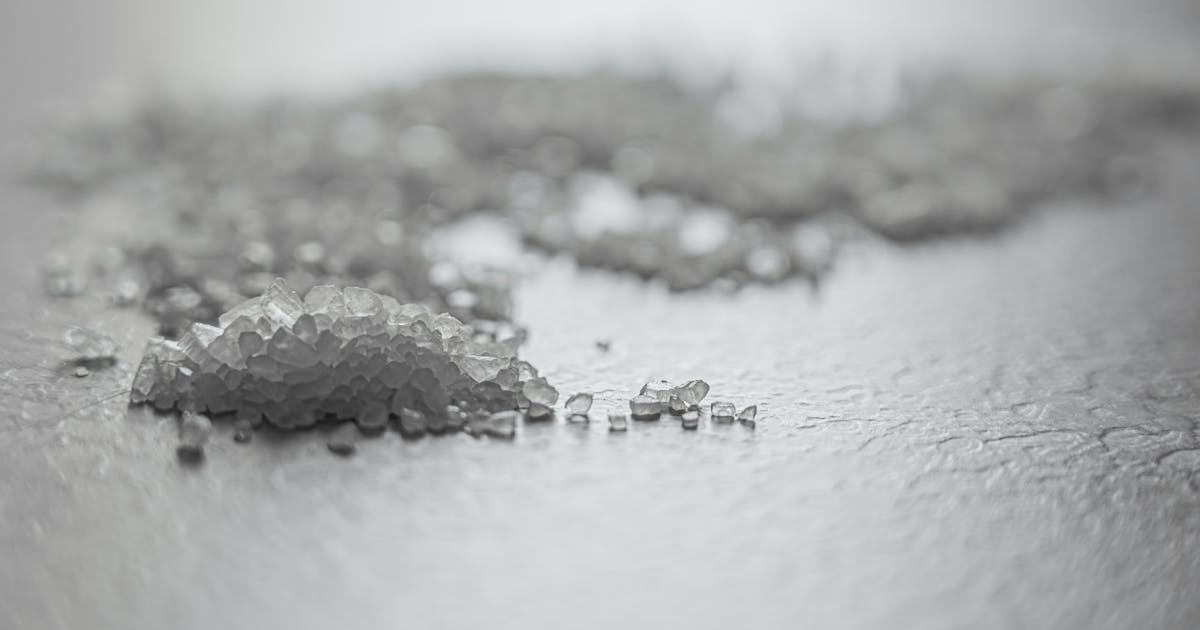
Salt for Sidewalks and Roads: How to De-ice and How Much to Buy for Winter
The first frost after rain, and the path by your building entrance, shop or house is already a sheet of glass. Some people spread sand, some salt, some whatever the hardware store had, and in spring they wonder why the paving cracked and the lawn went yellow. Here is what to put on sidewalks and roads, how much salt to buy for the winter and how to avoid damaging the surface.
How salt melts ice
Common salt (NaCl) lowers the freezing point of water. A crystal dissolves in the thin film of moisture on the ice, forms brine, and the brine melts the ice around it. A concentrated solution stays liquid down to -21°C, but in practice salt works quickly only down to about -7 to -10°C. The colder it is, the slower it acts and the more you need.
| Temperature | How salt performs | What to do |
|---|---|---|
| 0 to -5°C | Fast, 10-20 minutes | Normal dose |
| -5 to -10°C | Slower | Dose +30%, clear the snow first |
| -10 to -15°C | Weak | Mix with sand 1:3 |
| below -15°C | Hardly works | Sand or calcium chloride |
Salt, sand or a mix
- Salt removes the ice itself. The surface is clean afterwards, but in hard frost it is nearly powerless.
- Sand melts nothing, it only adds grip. It works at any temperature, but it gets trodden into the snow, carried indoors and has to be swept up in spring.
- A sand and salt mix is the municipal standard. Salt keeps the sand from freezing into lumps and softens the crust, sand keeps the grip when salt can no longer keep up.
For a private yard or a shop entrance in a typical Kyiv winter (most days between 0 and -10°C) plain salt is enough. Keep a sand mix in reserve for a week of hard frost.
Which salt to buy
Any coarse rock salt works for de-icing (grind 1 or 2, crystals 1-4 mm). The bigger the crystal, the longer it stays on the ice and the less it is washed away by the first thaw.
- Rock salt, grind 1, in 25 kg bags is the most practical choice for a house, a homeowners association, a shop or a cafe. A bag is easy to carry and to keep in a storeroom or garage. For example, rock salt grind 1, 25 kg or Polish rock salt grind 1, 25 kg.
- Technical salt by the tonne for roads, large car parks and industrial sites. Cheaper per kilogram, but it needs covered storage. A manager prices these volumes, see wholesale salt.
- Not suitable: fine "Extra" salt (dissolves fast, runs off and cakes), tablet salt (you pay for a shape the ice does not care about), iodised salt (you pay for iodine that does nothing here).
We covered the difference between food-grade rock salt and technical salt separately: food vs technical salt. In short, the chemistry on ice is the same; the difference is purity, certification and price.
How much per square metre
- Prevention (before frost or snowfall): 15-20 g/m², about a tablespoon per square metre
- Thin ice, glaze after rain: 20-40 g/m²
- Thick crust, -5 to -10°C: 40-60 g/m²
- Severe icing: 60-80 g/m², better mixed with sand
At 20-40 g/m², one 25 kg bag covers 600-1,250 m² per treatment. More is not better: excess salt does not melt ice faster, it just ends up in the soil and on shoes.
How much to buy for the winter
| Site | Area | Per treatment | Per season (20-30 treatments) |
|---|---|---|---|
| Private house: path and driveway | 60-100 m² | 2-3 kg | 2-4 bags of 25 kg |
| Shop, cafe or pharmacy entrance | 30-50 m² | 1-2 kg | 1-2 bags |
| Shop car park | 300 m² | 9 kg | 8-11 bags |
| Homeowners association yard | 500 m² | 15 kg | 300-450 kg |
| Shopping centre car park | 5,000 m² | 150 kg | 3-4.5 t |
For large sites and roads, formulas with examples are in how to calculate your de-icing salt needs, and the buying calendar is in winter preparation: salt stock for the season.
How to spread it properly
- Snow first, then salt. Salt thrown on loose snow is wasted on what a shovel could remove. Clear the snow, then salt the crust that is left.
- Salt before the ice. A thin layer before frost or wet snow stops ice bonding to the surface. It is then twice as easy to clear, and you use less salt.
- Spread evenly. Heaps of salt leave pits in the ice next to a skating rink. For a large yard or car park a hand spreader pays for itself.
- Clear the slush. Once the ice has softened, scrape it off. Brine that refreezes becomes new ice.
- Do not salt "just in case". In dry frost with no precipitation salt is not needed.
How not to ruin paving, concrete and lawns
- Fresh concrete and screed less than a year old are especially vulnerable. Brine soaks into the pores, freezes and expands, and the surface flakes. Use sand here.
- Paving slabs of good quality, with a frost resistance rating, tolerate moderate doses. Cheap pressed slabs without a rating can crumble after a few winters. Do not exceed the rate.
- Lawns and flower beds. Do not pile salty snow on them. In spring, water the path edges to flush the salt out of the soil.
- Pets. Salt irritates dogs' and cats' paws, so wipe them after a walk.
- Shoes and cars. Salt stains come off with water and vinegar. Wash the car underbody after winter.
Storing salt before and during winter
Salt draws moisture from the air and cakes into a block. Keep it in a closed bag, on a pallet or shelf rather than a concrete floor, in a dry storeroom, garage or under a roof. Roll an opened bag shut tightly. More in how to store salt.
In short
- Down to -10°C plain coarse rock salt works; below that, mix it with sand.
- The rate is 20-40 g/m²; one 25 kg bag covers 600-1,250 m² per treatment.
- A private house needs 2-4 bags for the winter, a homeowners association yard 300-450 kg.
- Shovel the snow first, salt the crust, or better still salt before the ice.
- Buy before the first frost: in December salt gets more expensive and runs out.
Buy sidewalk salt from SOLTIS
Coarse rock salt in 25 kg bags is in stock at our Kyiv warehouse: rock salt in the catalogue. Pickup from 2a Novokostiantynivska St, delivery across Kyiv from 5 bags and by Nova Poshta across Ukraine. For homeowners associations, businesses and roads we price volumes from 1 tonne, contact a manager.